
Home
It's where you find it.

Home
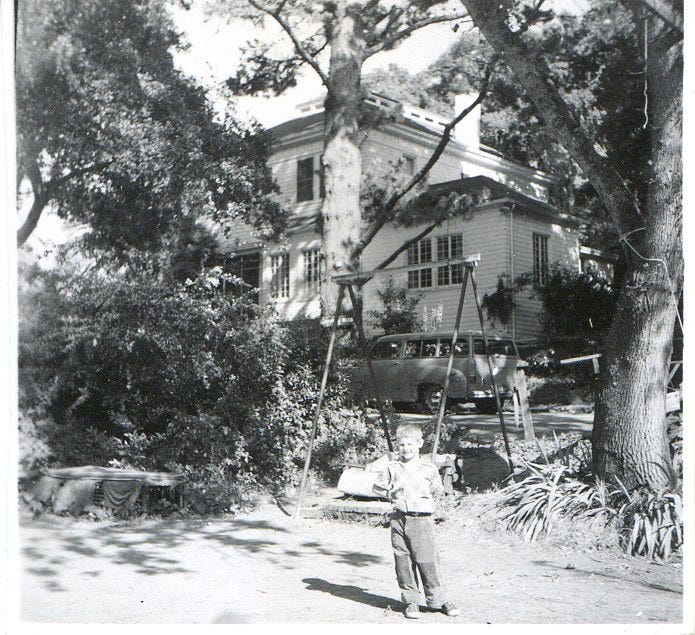
A long time ago in a galaxy far, far away — a place I once called home
(Note: this was first published on the old blog back in 2019. A lot has changed since then — for Hollywood in general, and at my old home studio in particular — sadly, not for the better.)
Cliché says home is where the heart is, but the heart can be a fickle mistress of ever-shifting attachments, which renders the whole notion of "home" a bit elusive. That's not necessarily a bad thing. Given that life has a way of knocking your gyros off kilter when you least expect it — turning one's internal guidance system into a mass of flashing red lights — the ability to adapt and call a new place "home" serves as an emotional survival mechanism. Home can be the house you grew up in, the town where you went to school, the place you raised a family, or a bench where you sleep in the middle of a big, ugly city. It all depends on the circumstances of the moment.
"You can't go home again," Thomas Wolfe declared in his famous novel, and he wasn't wrong. I left my third home to head for the City of Angels as a young man imbued with a blind sense of optimism borne on the wings of hope and ignorance. Forty years later I retired as a worn-out workhorse ready for the glue factory, and by then —just like the tree, the swing, the car, and the house in the photo above — most of the “homes” I'd known along that journey had vanished into the ether. Gone too was that little boy standing there in the afternoon sun with no earthly clue that he'd someday wind up in Hollywood.
Near the end of Wolfe's novel, the main character comes to a realization.
"You can't go back home to your family, back home to your childhood ... back home to a young man's dreams of glory and of fame ... back home to places in the country, back home to the old forms and systems of things which once seemed everlasting but which are changing all the time — back home to the escapes of Time and Memory."
Right again, Mr. Wolfe. Most of the people I'd left behind were gone, some into eternity, the rest having moved on with their lives. Time waits for no one, and it didn't wait for me. This came as no surprise, but the door-slamming finality of all those changes delivered a sobering reality check on the finite nature of life.
Two years after I wrapped my last show, packed up the car, then watched LA disappear in the rear-view mirror, I headed back down Interstate 5, driving through the endless stretch of agricultural flatlands, then up and over the Grapevine into the LA Basin. My first stop was to walk around the old neighborhood, past my apartment — once "home," now surrounded by a chain link fence with a stern "No Trespassing!" signs. Posted in front was a multi-color banner declaring that a much bigger and vastly more expensive multi-story apartment building would soon occupy the space.
The only constant is change.
I had dinner with old friends, lunches with former co-workers — some retired, others still working — and at long last sat down for a martini and a fabulous meal at Taylor's Steakhouse (no relation, unfortunately), a dinner I'd long meant to enjoy, but never got around to during my four decades in LA. The Uber ride after dinner was memorable, the driver an ebullient Mexican immigrant who serenaded us with mariachi songs all the way back to the apartment where I was staying. If not for the martini and wine, I might not have fully appreciated this, but sufficient libation can turn what might otherwise be an ordeal into something fun, underlining the astonishingly diverse population of the modern Rome, Los Angeles.
My brief three day visit was all good, as the saying goes — very good, actually — but returning to the CBS Radford Studio might have been the most satisfying experience of the trip. I spent most of the last fifteen years of my career helping to light shows on that lot, working on every one of those eighteen sound stages. The tides of change had not spared Radford, either, where I found ten charging stations on the top floor of the six-story main parking structure — one of which would charged the battery of my car while I made the rounds on the lot.
Hey, not all change is bad.
After doing time at Paramount, Sony, Warner Brothers, and Universal, working at Radford — a much smaller, friendlier studio — was a revelation. Until then, I’d never I had a "home lot," so I stayed there as long as possible. Like a tumbleweed, an itinerant film worker goes where the employment winds blow, but after doing an occasional pilot or show at another studio, I always returned to Radford.
And so here I was again, taking the stairs from the top floor of the parking structure all the way down past the Radford Horse, across Gunsmoke Avenue and up Gilligan's Island Road past Stages 2 and 3, on around Stage 9 (where Seinfeld was filmed) and down Republic Avenue to Stage 14, where I spent five years grinding out more than a hundred episodes of Melissa & Joey. There I ran into a Key Grip and Best Boy I'd worked with many times on other shows, who were in the midst of one of the last pilots of the spring season. I continued on to Stage 15, 12, and 10, past the special effects shop and mill, and finally to the lamp dock, where half a dozen familiar faces awaited. We shook hands and traded a few lies, then I went to lunch at the studio commissary with the Best Boy of my last show.
It felt warm, it felt good — it felt like I'd come home.
This wasn't something like The Swimmer, an interesting if bizarre movie starring Burt Lancaster from the late ‘60s — I wasn't searching for some ineffable mystery from bygone days. Maybe that'll come in ten or twenty years, should I be unlucky enough to fall into the living-death embrace of dementia, but this was just a welcome stroll through the recent past. In that, it was exactly what I needed right now: a reminder of who I once was, and who I am now.
On the way back to my host's apartment, I made one last stop down a quiet street behind a Trader Joe's. There, still living on the same patch of tired grass under a pine tree, was a homeless man I'd gotten to know over the last fifteen years. I’d bring him cold bottles of water and Gatorade during the sweltering summer months, and occasionally delivered a burger, fries, and a coke from the nearby Astro Burger. When he seemed to need it, I'd give him a few dollars, but in all that time he only asked for money once. "Keith" was — and remains — an articulate, engaging, observant guy. He's afflicted with a mental instability that precludes him from joining the mainstream of society, but that doesn’t make him any less human. I'd stopped to say goodbye when I left LA two years ago, but he was gone at the time, and now I wondered if he'd still be there, or if he'd remember me — and in that case, what his reaction might be.
He was folding up a blanket as I approached. He turned, saw me, and grinned.
"Mike Taylor, where the HELL have you been?" he said.
After a handshake and a hug, I explained my absence, then we had the usual wide-ranging discussion about the state of Hollywood, America, and the world, as if no time at all had passed. He'd lost a few more teeth in those two years, but otherwise looked okay. As always, the conversation wound up with him repeating his mantra that "All the world needs is peace, love, and understanding."
I couldn't argue with that.
When it was time to go, I slipped him a twenty dollar bill (which he discreetly pocketed without inspecting), then wished him well. As I drove away, it hit me that Keith wasn't actually "homeless" at all — his home was that patch of grass under the tree — and if such a tenuous arrangement doesn't comport with my own middle-class notions of stability, safety, and "home," well, that's my issue, not his.
Then came the familiar drive north, over the Grapevine and through the valley back to the Home Planet, where the rituals of weed-whacking and spring planting awaited. Driving the long expanse of I-5 allowed my mind to wander, and there was much to think about on the way home. Although I wasn't able to see everyone on my list, I'll get to them at some point: this wasn't the last time I'll head south.
LA isn’t home for me anymore — and maybe it never was — but it’s still a great place to visit.
i spend wayyy too much time thinking about the concept of home so when this arrived in my email i saved it to read later and so glad i did. a lot of truth and feeling in your writings. for myself, i think i'm learning that home is within. maybe i want this to be true after some major changes in my life over the past 3 yrs but i like to think it is true as this way you can be home wherever you find yourself ~
Very well written, Mike. You really take us back....
Evelyn Waugh's novel "Brideshead Revisited" also deals with the going-home theme. I'm rereading the book, which is so good; and want to watch the film with Jeremy Irons next.