
Industrials
A job is a job.

Image courtesty of FreePix
Back in the good old/bad old days, I’d take an occasional gig working on industrial films — infomercials made for employee education and training, or to promote a product to potential customers at trade shows. As Wikipedia puts it: “An industrial video is a type of sponsored film (such as an educational film) which prioritizes pragmatism over artistic value.”
The focus on “pragmatism over artistic value” meant that these jobs were typically straightforward, with no budget for glowing, painstakingly-lit product shots or celebrity star power. They weren’t exactly quick-and-dirty — we made each shot look as good as time and circumstance allowed — but with thin budgets and tight schedules, there was only so much to be done. Most of the industrials I worked were shot on 16 mm film with a small crew: often just a gaffer, grip, and swing man to work with a DP/operator and camera assistant, a one or two person art department, a sound mixer and a handful of PAs, one of whom usually ended up holding the boom. Industrials didn’t pay as well as television commercials, but the jobs were usually low-key and casual, absent the pressure and tension of big-dollar advertising jobs. There was often more laughter on set, which eased the sting of lower rates and the typically dull subject matter. There’s nothing remotely interesting in filming a talking-head executive or manager in an office as he recites the mind-numbing details of product manufacturing and distribution, but when better gigs weren’t coming — especially in the early years — I took whatever I could get.
Such is the life of the freelance Hollywood workbot, a hunter-gatherer constantly on the lookout for his next meal in the freelance world of the celluloid veldt.
My first industrial was a one-day shoot for Silhouette Romance Novels (emo-porn for fans of bodice rippers), a short film meant to induce orders from buyers for the big and small bookstore chains of the day.* Unlike most industrials, this one splurged for an actual celebrity: Ricardo Montalbán, who’d achieved widespread fame on the television show Fantasy Island.
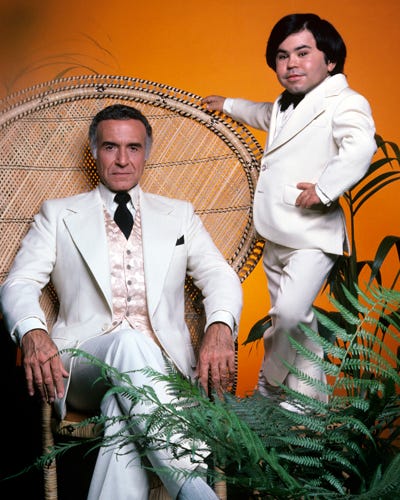
After filming sequences featuring the new lineup of Silhouette’s literary offerings, our star made his entrance, resplendent in that trademark white suit: the living, breathing Mr. Roarke himself … and yes, I was impressed. Fantasy Island might be total schlock, but Ricardo Montalbán was the biggest star I’d seen up close at the time, and he did not disappoint. Dapper, classy, and dignified, he was a total pro, nailing every line in his precise, exotic accent — especially the finale, which he crooned with a knowing smile, a glint in his eyes, and a lilt in his voice:
“Romance the way it once was ... and profits the way they can be again!”
If that didn’t warm the hearts and quicken the pulse of those book-sellers, nothing would.
We worked more than sixteen hours that day on a flat rate, but I didn’t care. Every day on set was a blast back then — I was just happy to be there ... and getting paid.
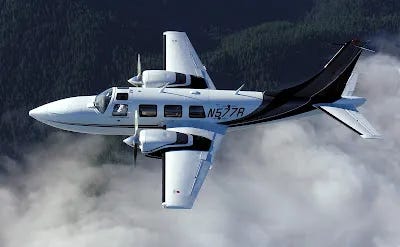
Cut to a slow summer ten years later, when a call came to gaff an industrial shoot for Piper Aircraft. With no sound department to slow us down by demanding “QUIET!” or “We need room tone!” on set, the crew consisted of a producer/director, DP/camera operator, camera assistant, grip, gaffer, and a single PA. We gathered at John Wayne Airport in Orange County early one morning, where I found the grip at the bar sipping mineral water while reading a worn paperback copy of “The Federalist Papers.”
This was not the sort of grip I was accustomed to. Not only did he consider himself something of an intellectual tough guy, he was also a vocal vegetarian determined to dispel any and all stereotypes that haunt those who follow the meatless path.
“I’m strong,” he assured me … not that I’d asked, mind you.
While the director, cameraman, and AC climbed into a Piper Cub with a camera mounted where the side door had been, the rest off us piled into the Piper Aerostar picture plane, a twin-engined aerial hot rod capable of speeds over 250 mph. The two planes took off and headed east over the San Gabriel mountains, where the camera plane filmed suitably picturesque shots of the Aerostar in flight. We landed at the airport in Lake Arrowhead to shoot takeoffs and landings against the spectacular mountainous background, then headed back into the sky. A few minutes later we were high over the Southern California desert when our pilot — an ex- Naval aviator who had flown fighter jets off aircraft carriers for twenty years — turned around with a grin.
“Hang on,” he said, then snapped the Aerostar ninety degrees on its axis, the wings suddenly vertical. I looked to my left, straight down at the desert floor ten thousand feet below as the plane launched into a vertiginous attack dive — a long, swooping loop that flipped back in a steep bank to the right, then shot up until we were again horizontal and directly under the camera plane. Mere feet separated the two aircraft, flying so close together that a miscue by either pilot could send us all spiraling into the Next World.
Riding an aerobatic roller coaster in the sky like this was a thrill I’d always wanted to experience — I was having way too much fun to be scared. My faith in the skill of our pilot freed me from worries, and besides, this was all out of my control. If Something Bad happened, there wasn’t a damned thing I could do about it. Sometimes you just have to hold on tight, hope for the best, and enjoy the ride.
We were all having a giddy blast … except the grip in the back seat, whose countenance had taken on a pale verdant hue unlike that of any human I’d ever seen: he’d literally turned green. Physically strong he might be, but this grip was on the verge of blowing vegetarian chunks as we careened through the high desert air — and no good could come of that.** Alerted to the imminent danger, our pilot eased off the throttle and resumed steady level flight. Saved by the proverbial bell, the grip’s stomach gradually settled down from Defcon One, and we got on with our day.
It went well. We spent the next few hours touching down at a series of small airports out in the desert, whereupon we’d disembark to crank out a few more shots as the pilot took the locals up for a high-speed aerobatic spin. When the producer/director was finally happy, we flew back to the airport, our work day over.
This was the best day working an industrial I ever had — the most fun by far — although our grip might not agree.
Ah well, you can’t please everybody.
* This was twenty years before Amazon marched out of the digital sea like Godzilla to crush the life out of Crown Books, Borders Books, and Barnes & Noble.
** It’s no joke: here’s an excellent tale of the stomach-churning hazards that can accompany aerobatics.
"Hold on tight, hope for the best and enjoy the ride."
Words to live by.
Always enjoy your work here ...it's nice to see someone who enjoyed their profession. J
Great story. Industrials (I indulgently call them "docs") can be a ton of fun, as you've described. Just as much fun as second unit, but with a smaller paycheck. That's a trade I was frequently glad to make.
I've never seen a green face, but I've felt green a few times. If you're not prepared, an aircraft is the worst place to be when you know you're gonna barf.