

And this isn’t it.
On a recent Friday, weary of the usual whatever’s-in-the-fridge lunch at home, I drove around the narrow sliver of a bay that defines my part of the world to a little oyster shack that was built out over the water more than seventy years ago. It’s a popular spot with locals and tourists, but rather than the usual array of sedans and SUVs out front, the parking lot was fully occupied by a fleet of extremely expensive German sports cars.
The winding two lane pavement of California Highway One is catnip for those who love fast, outrageously expensive automobiles, drawing car clubs from all over the San Francisco Bay Area. I once found a lineup of gleaming Ferraris, Lamborghinis, and McLarens parked in front of this humble oyster shack — more than a dozen — none of which left the showroom for less than half a million dollars.
I made a U-turn to park down the road by the water, and while walking back, noticed a shiny black pickup truck with a miniature Steadicam rig mounted to the hood. At the back of the truck were two young men putting a slick little image-stabilizer rig through its paces with a small DSLR camera. I stopped to chat, and it turned out these two had been shooting on-the-road footage of those German sports cars for a video to be distributed on social media.
This wasn’t just some rich kids hobby, either: it’s their business, and they’re making a living at it.
Both were nice young men, full of enthusiasm, energy, and entrepreneurial spirit — which is what it takes to succeed at any form of film-making — who seem to have blazed a viable path into the biz on their own terms using the tools of this Brave New Digital World. I don’t know if they’ll stick with the automotive stuff or eventually move on to other cinematic ventures, but the real-world skills they’re learning now would enable them to do bigger and better things in the future.
YouTube has become the Hollywood equivalent of baseball’s minor leagues, where talented young people learn the ropes of creating visual media before stepping into the spotlight. It’s a modern twist on a cycle that’s been in motion since humans first moved out of the Neanderthal caves: youth finding new ways to tell stories for their generation.
The title of this post, of course, is misleading: I don’t know the future of Hollywood any more than you do— nor does anyone else, for that matter — but despite the growing (and to me, unfathomable) popularity of Verticals, audiences will continue to seek the big-screen experience. Back in the ‘50s and ‘60s, Cinerama, Technicolor, and Vista Vision delivered the most dazzling visuals of their era to lure the viewing public out of their homes and television set to theaters, and nowadays the large format IMAX films offer the highest resolution state-of-the art movie experience.1 People still want that, which is why screenings of Christopher Nolan’s The Odyssey — filmed entirely with huge IMAX cameras — have been sold out for weeks.
It’s possible that future cinematic spectaculars will eventually be transmitted directly into our brains — the ultimate immersive virtual-reality experience — but until then, IMAX will have to do.
Still, the desire for more intimate, thoughtful stories will persist. Maybe AI will take over film-making and maybe it won’t — my crystal ball is opaque on that — but one way or another, indie films will keep doing what they’ve always done: telling stories the studios can’t and/or won’t. With or without AI, there will always be artists who explore the liminal spaces that don’t reek of massive profits, and thus won’t attract the big fish of the film industry.
“What’s past is prologue,” the Bard tells us, and from the days of Max Sennett, Charlie Chaplin, and Orson Welles, young film-makers have made the most of the new tools at their disposal. It happened for my generation in 1969 when Easy Rider showed Hollywood a fresh approach to telling stories on film by shooting on location with small crews using lightweight camera and lighting equipment.2 This helped pry the door open for a new wave of young directors — Friedkin, Coppola, Lucas, Spielberg, and Ashby, among others — and this process of renewal is still underway, but rather than serve their apprenticeships in the world of low-budget features, today’s young film-makers hone their cinematic chops on YouTube … while earning money.
It’s a new world.
Although this future may work out well for young, highly-motivated “content creators” — to use the jargon du jour — it probably won’t be good for below-the-line crews, union or not. Every technological revolution inflicts collateral damage on those at the wrong end of the equation, who aren’t understandably unhappy about losing their livelihoods. The counter-argument is that new technologies generally create more jobs than they destroy, but tell that to the people who can no longer pay the rent because they’ve been replaced by computers. Old skills don’t always translate to new ways, and that brews trouble. It happened in the 19th century when the Luddites violently resisted the mechanization of the textile industry, and similar if less-bloody disruption hit the ranks of labor when the oil shocks of the early ‘70s sparked an automotive revolution that sold fuel-efficient imports like hotcakes while Detroit gas-hogs clogged dealer showrooms. The UAW workers back then took a beating from which they’ve never fully recovered.
It’s happening now in Hollywood, where employment options have thinned considerably in recent years thanks to industry consolidation and the flow of productions chasing fat financial incentives offshore, and although we hear occasional talk of “federal tax credits” to keep more productions from fleeing overseas, I doubt the current regime in Washington DC will act in a meaningful way to help rank and file workers below the line.
The new digital technology will continue to alter the cinematic future for better and worse. What some see as a “democratization” of film-making — allowing many more voices to tell their stories on screen — others experience as the end of a way of life that has provided for them and their families. So the question lingers: will the AI revolution create more jobs than it destroys? New job categories have already emerged to serve artificial intelligence, but it’s unclear how long those tasks will endure before they too are absorbed by the AI Machine. If the day arrives when a list of prompts fed into a computer can spit out movies and television shows the viewing public wants to see, the net loss of jobs in Hollywood and beyond will be devastating.
Still, denying reality won’t help. The tsunami of change has arrived, releasing the digital genie from the bottle, which means only those able to adapt will survive: the rest will be swept away.
That’s the future I see.
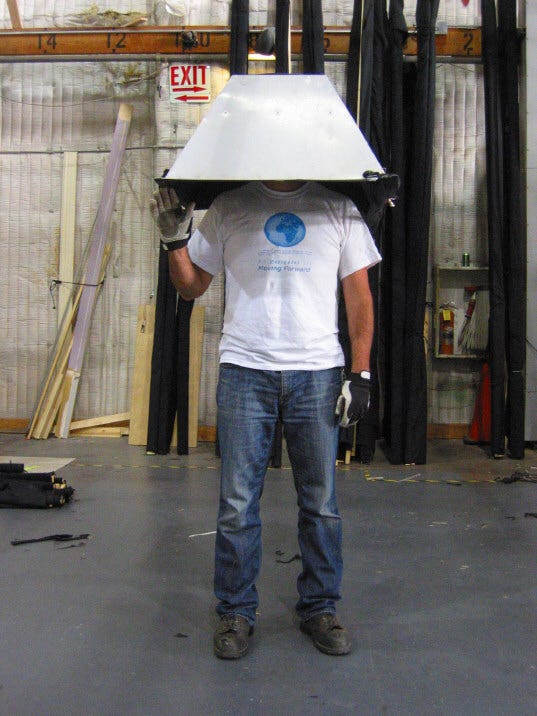
PS: The photo is of Dimmer Operator Jason Lord (or “Console Programmer,” in the modern vernacular of lighting terminology), during the wrap of one of my last shows in Hollywood. As a gag, he put this “Cronie Cone” — a device used to control light from movie lamps — on his head.
I’m not sure if the audio/visual spectacle offered by the Sphere qualifies as a true cinematic experience, but who knows how that venue will develop?
The French New Wave had already discovered this, of course, but each cinematic culture has to find its own way it its own time.
I'm a retired cameraman and I dabble in AI imaging for fun. I can make shots that would previously have cost tens of thousands and employ a dozen people, all with a few pennies worth of electricity and ten minutes at the keyboard. I both love it for what it can do and hate it for what it portends.
The future is unpredictable, the present is amazing and the past is past.
Driving up to Oakland on the 101 I was passed up repeatedly by a stream of fancy sportscars - souped up Mercedes, Lamborghinis, a Lotus even, et al. They had to be going somewhere to some event, I surmised, and lo and behold - it’s Car Week in Carmel! Maybe your bunch were heading down from the opposite direction. This has nothing to do with the sad state of the movie biz in Hollywood.