
Jaws
"Just when you thought it was safe ..."

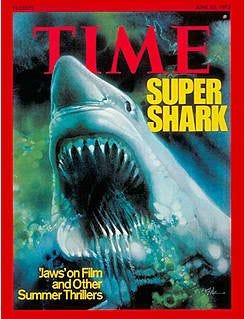
It’s once again the summer of “Jaws,” which scared audiences and delighted theater owners all over the country fifty years ago while earning vast profits for Universal Studios. Although Peter Benchley’s book had been a huge success, spending the better part of a year on the NY Times bestseller list, his story was larded with enough plot twists for three movies, so the screenwriters stripmined it for parts. Among other elements, they cut a subplot involving the mafia having its hooks into Amity’s mayor, and a soap-opera affair between young shark expert Hooper and Chief Brody’s wife, then boiled the story down to its dramatic core, emphasizing themes lifted from Ibsens’ play “Enemy of the People” and Melville’s “Moby Dick.”
Hey, if you’re going to steal, steal from the best.
I borrowed the paperback from a fellow minimum wage-slave at the pizza parlor where we both worked, and loved it — and naturally, was convinced that I should direct the movie. My vision had Telly Savalas as “Quint,” the shark fisherman, Michael York as “Hooper,” the shark expert, and after that … well, I wasn’t too sure. Let the casting director earn her money fleshing out the rest of the roles.
Fortunately for Hollywood and the worldwide viewing public, Universal gave the nod to Steven Spielberg rather than handing the keys to a wet-behind-the-ears pizza cook who had yet to finish his 30-minute college thesis film, let alone earn a degree. Cut to the following summer when — rather than brushing sand from Martha’s Vineyard off a director’s chair with my name embossed on the back — I drove 35 miles to the nearest theater to see “Jaws,” where I sat in the very front row staring nearly straight up at the screen, utterly enthralled. Two hours and ten minutes later, I had but one conscious thought as the credits rolled: “This movie is going to make a LOT of money!”
Well, at least I was right about one thing.
Six years earlier, “Easy Rider” shot a flare over Hollywood: a signal to the aging, sclerotic studios that the times, they were a’changin’. A few years later came “The Godfather,” which sent another shock wave through the industry, further demonstrating that a young audience hungry to see new stories told in new ways was out there — and those kids had money to spend. Then came “Jaws,” which pretty much sealed the deal as a new generation of writers, producers, and directors planted their flag on the high ground of Hollywood.
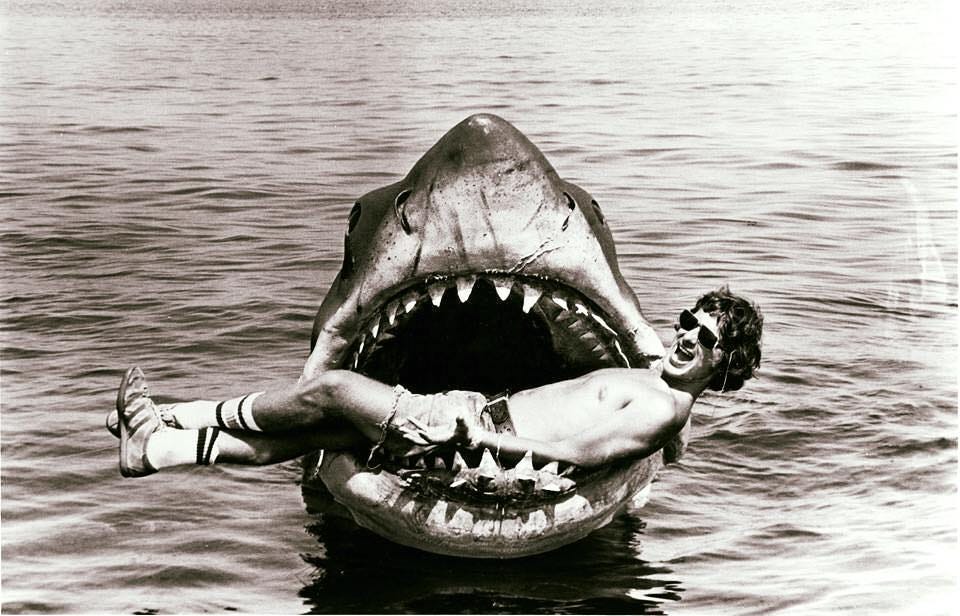
As was the case with so many modern Hollywood classics, the filming of “Jaws” was a nightmare plagued by difficulties — in this case, an ever-changing script, a budget that blew through every hopeful estimate like a horse fleeing a burning barn, a mechanical shark that seldom worked, and a terrified 27-year-old in the director’s chair. It was no accident that the on-set crew referred to the film as “Flaws.”
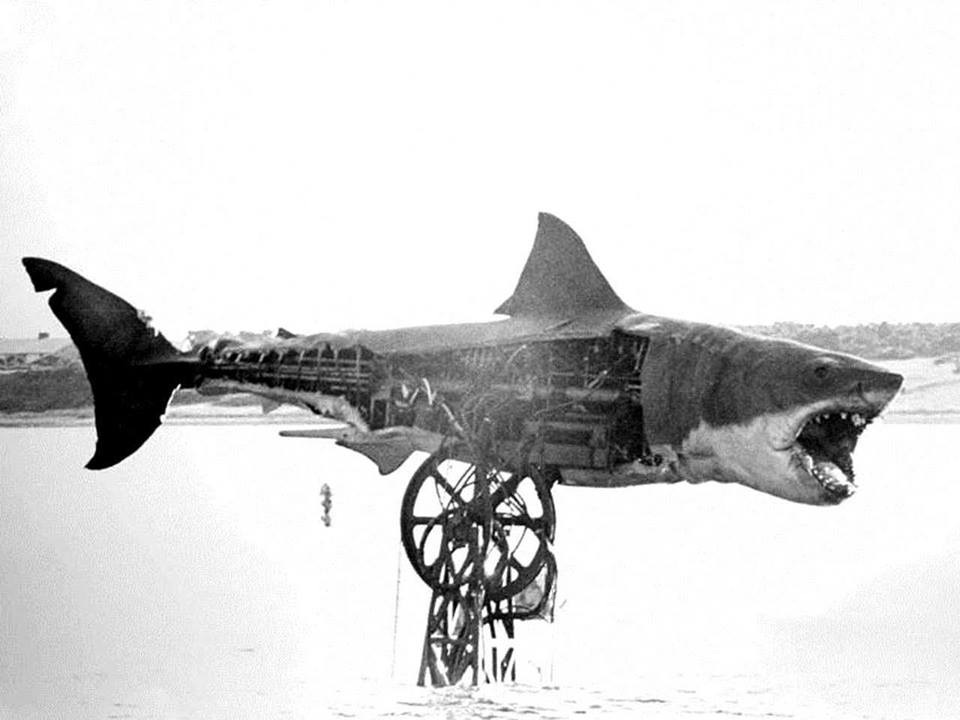
But as the saying goes, “Put enough pressure on a lump of coal and you get a diamond,” which is how a true classic emerged from all that chaos, and in some ways, because of it. The constantly malfunctioning mechanical shark, “Bruce,” turned out to be a blessing in disguise, forcing young Mr. Spielberg to focus on the characters and the human drama rather than the monster, which elevated the film in every way. Sometimes less really can be more.
The story will be told in a new documentary called Jaws at Fifty — scheduled to air on July 10 on National Geographic, then streaming on Disney+ and Hulu on July 11 — which promises to tell about the “making-of” from the POV of insiders who were there. I’m really looking forward to hearing those stories.
Given the inherent difficulties of film production, every movie generates a wealth of good stories, big and small. Many years later, I worked with two people who’d been on the “Jaws” crew, a strapping young set lighting arc operator who plowed his way through the women of Martha’s Vineyard in after-hours romps, and another never-to-be-named individual tasked with driving a truck full of raw film stock from LA back to the set in Massachusetts. When the truck broke down and got stuck in the hot desert for a few days, the DP could no longer trust the film — which can be damaged by exposure to excessive heat — so the studio sent another load of film to the set. Meanwhile, that certain individual proceeded to sell the heat-treated film (which was still good, as it turned out) to various other production companies over the next year or so.
“I bought my first Harley with that money,” he grinned.
That’s Hollywood, folks.
With all this in mind, I watched a DVD of “Jaws” the other night, and despite a few seams here and there, it holds up remarkably well, with a few lessons for us today that have nothing to do with beaches or going back into the water. Roy Scheider and Richard Dreyfuss fully inhabit their respective roles as Brody and Hooper, and Murray Hamilton's portrayal of Amity’s oleaginous mayor “Larry Vaughn” is letter-perfect, but it’s Robert Shaw’s shark hunter “Quint” who owns this movie: you really can’t take your eyes off him whenever he’s on screen. Still, it seems to me that the mayor emerges as the real winner in the end. Yes, he’s been shamed and humiliated after browbeating Brody to open the beaches, resulting in the bloody deaths of one unlucky dog and two people in a matter of minutes, but with the monster shark finally dead, the little town of Amity is once again safe for tourists — and since Quint is literally in the belly of the dead beast by then, Mayor Vaughn doesn’t even have to pay the promised $10,000 fee for killing the shark.
Maybe that’s why “Larry Vaughn” was still Amity’s mayor four years later in Jaws 2, thus proving something we’ve all learned the hard way over the last benighted decade: that truly bad, me-first, money-grubbing elected leaders are even more dangerous and harder to get rid of than a monster Great White Shark.
Thanks for the heads up about the doc, I will look forward to watching it.
I had to look up "oleaginous" and now my vocabulary is one word larger! Great storytelling!