
The King

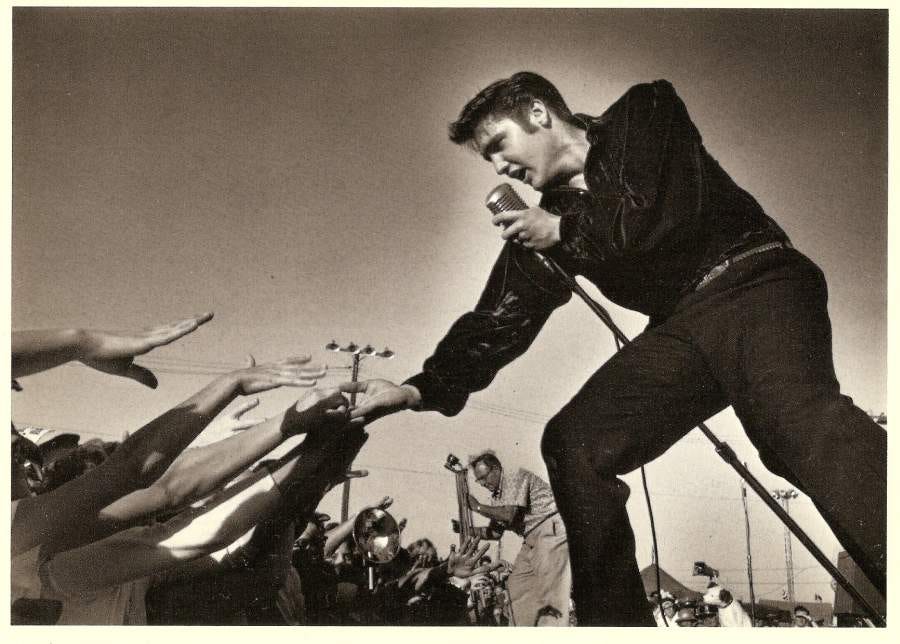
Elvis Presley in Tupelo, Mississippi, 1956
Photo by Roger Marshutz
(Note: this one survived several drafts of the book, but didn’t make the final cut.)
Elvis Presley blazed across the American cultural scene like a meteor when I was just a kid, too young to grasp what the media meant when they dubbed him “Elvis the pelvis,” or connect with the hype surrounding this young man from Tupelo, Mississippi. To my eyes, his national debut on the Ed Sullivan show was singularly unimpressive: there on our flickering black and white TV stood a nervous young man with a greasy pompadour, slapping his guitar while warbling “You Ain’t Nothin’ but a Hound Dog.” That his performance left a multitude of screaming teenage girls in the audience so giddily euphoric only confirmed my suspicions that this guy with “greaser” hair and swivel-hips was just another flash-in-the-pan enjoying his brief moment in the spotlight before fading back into obscurity.
A few years later I had the same thought about a new group from England called “The Beatles,” thus cementing my status as a young Anti-Nostradamus.
The kid from Tupelo rapidly morphed into a hugely popular cultural icon as a singer, singing-actor, and celebrity Army draftee. Elvis had the world by the tail, and for a while he really was “The King.” That he ultimately wound up a sadly bloated caricature of his lean and hungry younger self — sweating and staggering around the glittering stages of Las Vegas in a ludicrous white leather suit — served as a warning about the double-edged sword of the American Dream: be careful what you wish for.
I’ve always looked ascance at performers who achieved great success out there in Las Vegas. To me, it was an Outland World scorched by a merciless sun, uninhabitable without the miracle of air-conditioning, an elephant graveyard where entertainment dinosaurs like Wayne Newton play out their careers in an arena of shameless vulgarity and no-holds-barred excess. Given that Elvis finished off his career suckling on the swollen plastic teat of this neon-lit nightmare in the desert — America’s Adult Disneyland — I found it hard to accept that he represented anything beyond the commercial underbelly of America’s warped, needy communal soul. Everything about his time in Las Vegas embodied the “I Want More, Bigger is Better” ethos that led our society down the cheap and glitzy road of enormous automotive tail fins, padded bras, extra-long cigarettes, and the “World of Tomorrow,” each promising far more than could ever be delivered. Although some of his tunes were undeniably catchy, I couldn’t help viewing him through a jaundiced eye. That he remained wildly popular until the day he died — and beyond — only deepened the mystery. All I could figure was that it had to be about sex: American women all wanted The King in bed, while American men yearned to be him. Rather than anything remotely authentic, I saw Elvis as the punch line to a long-running joke.
During my post-college, pre-Hollywood life, I spent more than a year working behind the counter of a deli in Santa Cruz. One of our regulars would sail through the doors every afternoon dressed in a white leisure suit, his hair slicked back in a black pompadour, then strike a hip-thrusting stance like his hero, Elvis. Kenny was a cheerful guy in his late-twenties who wore the sweet, happy grin of someone we’d now call “mentally challenged,” and if his emulation of Elvis seemed a bit odd, it was the spiritual surfboard he’d chosen to ride through life. To each his own.
Kenny was hanging around the deli late one night when my shift ended, and as I headed out the door, he asked for a lift back to his apartment. Once there, he insisted I come in. All I wanted to do was go home — it had been a long day on my feet, dealing with endless waves of customers — but Kenny seemed wounded by my reticence, so I agreed to come in for a minute. Only when I stepped inside did I finally grasp how deeply rooted his obsession with Elvis really was: the entire apartment was a shrine to The King: velvet paintings and posters of Elvis lined the walls, with little plaster statues cluttering every horizontal surface. Elvis ashtrays, Elvis table lamps, Elvis everything.
It was more than a little creepy.
Grinning like a fool, Kenny watched me take it all in, giddy at sharing the temple he’d created to honor his living God. Until that moment, I didn’t realize just how far out on the limb of fantasy he really was.
I excused myself as soon as politeness allowed, then a couple of months later came the news that Elvis had died while sitting on a toilet in one of his many gilded bathrooms. Kenny came into the deli a few days later, a shell of his once-happy self. With his personal god having turned to dust in such a brutally public manner, the poor guy was utterly lost. I felt bad for him, but since I never understood the Cult of Elvis in the first place, didn’t really know what to say. Having lost a few icons of my own during the turbulent 60’s — JFK, Bobby, Martin Luther King, Hendrix, Janis Joplin, and Jim Morrison — the death of Elvis hardly came as a shock.
Kenny didn’t even want a sandwich: he just moped around looking miserable. One by one, the swing crew went over to pay our respects, and only then did he leave, a forlorn puppy trying to find his way back home. The death of innocence is an ugly thing to see — that sweet, happy grin was gone for good.
A few weeks later, so was I. Determined to give Hollywood a shot, I strapped a bulging pack and sleeping bag to the back of my motorcycle and headed for LA.
Calendar pages fly off the wall as the next ten years slip away. Now working as a set lighting best boy, I take a job on a movie filming in Oxford, Mississippi, a period feature set at the dawn of white involvement with the civil rights movement. Five weeks through our eight week schedule, we finish the day filming and go into nights, shooting from late afternoon until dawn, six nights a week.
Working twelve to fourteen hour days is tough enough, but you’re still more or less in sync with circadian rhythms that have governed homonid life since we first crawled out of the trees. Despite the brutal hours, going to work at sunup and heading back to the hotel after dark provided an illusion of normalcy, but switching to nights turned everything upside-down: suddenly we were going to work as the sun set, and staggering home well after it came up. Filming in the daytime is often a relatively simple matter of enhancing and maintaining existing lighting conditions — balancing or enhancing sunshine with artificial light to make each shot look good for the camera — but at night, every bit of illumination required to light each shot must be placed, powered, and adjusted by the set lighting crew. It takes a lot of cable and lights to make that magic happen, much of which has to be rapidly deployed, then moved and readjusted dozens of times throughout the night to meet the lighting needs of each individual shot. Only when the sky grows bright in the east can any serious thought be given to wrapping all that equipment, and by then — in the cold light of dawn — everybody is thoroughly exhausted.
Nights are a bitch.
With the help of three day-players hired out of New Orleans, we ground out the nocturnal cinematic sausage for two weeks, then in our final week, had a crucial scene scheduled where Ally Sheedy (portraying the earnest, idealistic young heroine of the story) was to attend an Elvis concert with Treat Williams, our male lead. The scene was to be filmed at the Tupelo Fairgrounds, where the young Elvis Presley and his band performed many times during the late 50’s.
We climbed into the vans at the hotel for the late afternoon drive from Oxford to Tupelo, and soon were rolling through red dirt country, a vast rural landscape of lush green jungle rising up from the rusty soil. Narrow dirt roads ran off either side of the highway and disappeared into the dense canopy of trees, where an occasional clearing revealed a collection of whitewashed shacks in a stark contrast to all that red dirt and greenery. This was rural poverty, and although it appeared much cleaner than the urban variety I’d seen in depressed areas of LA, that was probably just an illusion in the head of an outsider: poor is poor, wherever you are. It hit me that compared to those who lived in those shacks, I was rich, with a great job — a lucky man indeed — but all is relative in this life, and the knowledge of the long night’s work ahead thoroughly darkened my mood.
We hit the ground running, working hard and fast in the twilight running cable and setting up our lamps. The grandstands were packed with extras dressed in ‘50s garb — a handful of paid extras along with a large continent of Tupelo residents who’d responded to extensive radio promotions the production company ran the week before. Those good people were being paid exactly nothing for the privilege of being in the movie — a box lunch at midnight was all they’d get — making this exercise in recreating history a labor of love, their own personal act of fealty to the dead King.
The poor bastards had no idea what they were in for.
First up was the master shot, a wide, sweeping vista with the camera rising up on a crane to show the young Elvis (portrayed by one of the many Elvis impersonators-for-hire in the Tupelo area) kicking his band into song for the extremely enthusiastic crowd. The director wanted to shoot this from the front, but when dealing with an icon like Elvis — and really, there are no others quite like him — one must deal with those who legally own his image ... and that spells “money.” As I heard it, the going rate at the time for a frontal shot of an Elvis impersonator in action was five thousand dollars, while filming from the back ran just fifteen hundred. Being a low-budget production, you can guess where the crane went, carrying the camera smoothly up to reveal the stage, band, and Elvis from the rear, with the screaming crowd of extras facing the lens.
I watched from well behind the camera as the shot unfolded, taking in the whole scene — the stage, the band, the wildly cheering crowd packing the grandstand — and much to my surprise, chills suddenly ran down my spine at the realization that this is how it was. We’d recreated history, time-traveling back to the exact spot where these concerts took place thirty years before, and here were the sons and daughters of people who’d been in that grandstand, reliving a moment their parents experienced. This kid from Tupelo — a young truck driver with a guitar and a dream — had risen up from that red Mississippi dirt determined to do something and be somebody, and succeeded beyond his wildest dreams. At long last I began to understand what made Elvis so admired and loved — what made him The King. It was an epiphany unlike any other in my life.
It was also the high point of the night. Once the shots featuring Elvis and the band were done, we went in for the dialog — “coverage” — and the dull routine of tedium returned. Move the lights here, do the shot, move the lights there, do another shot: repeat ad nauseam. By 2:00 in the morning, the unpaid extras began drifting away, their enthusiasm drained by take after repetitious take. Civilians are invariably disappointed by the plodding mechanical reality of making movies as it dawns on them that it’s not all thundering rock and roll, thrilling car chases, and spectacular explosions. Filming a movie is mostly a long slog of waiting for someone else to do their job before you can do yours, then stepping back to allow others to do their work. For the crowd in the grandstands, the real action was over once the band left: the rest was filming the same dialog over and over again as the camera moved from one character’s perspective to another. That gets old in a hurry.
The volunteer extras were gone by three in the morning. The second AD and production assistants kept herding the paid extras tighter and tighter in the background of each shot until the sky began to morph from black to gray. We got the last couple of shots just before sunup, after which the actors and director were driven back to the hotel.
With the sun climbing steadily higher, we wrapped our cable and lights for another hour, carrying all the gear back and loading it into the truck before crawling into the van for the long drive back to our hotel. Fortunately — as always — there was a cooler of cold beer in the van.
The aches, pains, and paycheck from that endless night are long gone, but what lives with me still is that magical moment when I finally came to appreciate Elvis Presley for what he meant to the people from whence he came — and by extension, to my generation. Most of us will be long forgotten in a hundred years, but history will testify that for a brief incandescent moment, Elvis Presley really was king of his world.
Elvis Presley, Jan 8, 1935 — Aug. 16, 1977
This is another great insight into two worlds I know little about. I never understood the fervor for Elvis, either, and had thought little about it. And excellent read. Thank you. ~J
Our friend Paula Lewis really admires your writing. I agree.