
Warren Oates

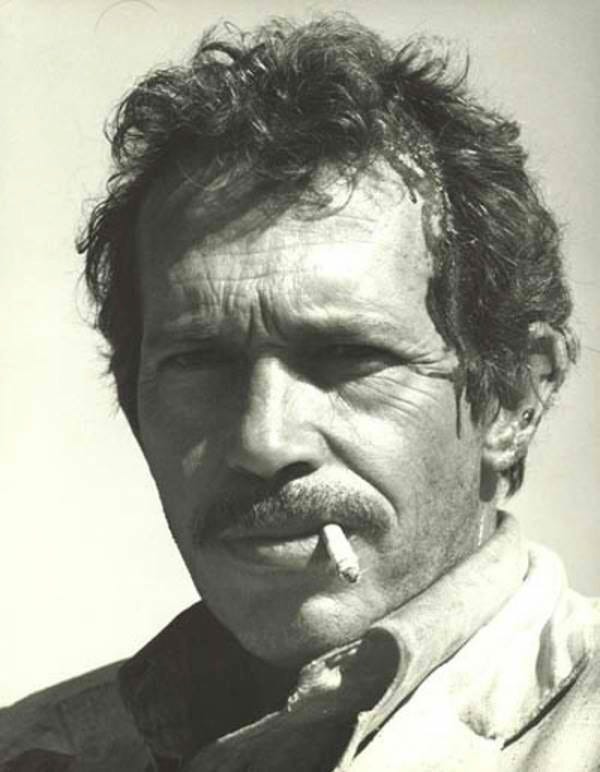
The late, great Warren Oates: July 5, 1928 — April 3, 1982
Here’s another from the Wayback Machine, a post that didn’t make the book.
Every journey begins with the first step, so they say, and the genesis of my own Hollywood adventure traces directly back to a class I took on a lark during the final quarter of my first year at a university. After dutifully fulfilling the two-year requirements at my local junior college, I transferred to the big school where I managed to get through the first two quarters without being kicked out — but when spring quarter rolled around, only two of the classes offered applied to the major I’d mistakenly chosen, leaving an open slot on my academic dance card. At liberty to take any class at all, I picked one called "The Screenplay," which sounded like fun … and turned out to be a lot more than fun. I had a blast, seeing dozens of movies I'd never heard of (everything from Pierrot le Fou to The Lady from Shanghai), reading and discussing several screenplays, and as a final project, writing the first twenty pages of an original (and very bad) screenplay.*
This was the first university class to fully interest and engage me, and although I didn’t realize it at the time, it set me on the road to Hollywood.
During the course of that quarter, Esquire Magazine (which was a big deal back then) published an issue that instantly became required reading for the class. On the cover was the starlet of a yet-to-be-released movie called Two Lane Blacktop, written by Rudy Wurlitzer and directed by Monte Hellman, starring two popular musicians of the time — James Taylor and Dennis Wilson — and a young model-turned-actress named Laurie Bird. Hailing the film as "movie of the year," Esquire printed the entirety of Rudy Wurlitzer's screenplay in this issue.
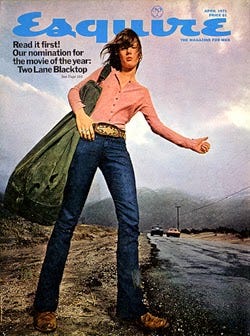
Esquire Magazine, April 1971
For a mainstream-media magazine to print the screenplay of a low-budget movie that had yet to hit theaters was unheard of — I'm not sure it's happened before or since — and the screenplay was a terrific read. I loved it, and couldn't wait to see the film. When it was finally released, I had to make a 180-mile round-trip drive to see it … but alas, great expectations don’t always survive the transition to reality. The movie had the requisite gritty bleakness I — as a hormone-addled young man at the time — liked, but James Taylor was hands-down the worst actor I'd ever seen in a Hollywood movie, and although Dennis Wilson wasn't quite as bad, that's mostly because the script didn't give him much to say him to say.** Laurie Bird — who had a rough life that came to a sad end eight years later — didn't exactly burn up the screen either, and seemed to have been cast mostly for her waifish, petulant-tomboy looks more than anything else. I never quite understood her appeal, but the youth culture back then was obsessed with a bony, emaciated vision of femininity best exemplified by Twiggy, one of the top models of the time.
Put it this way: as an actress, Laurie Bird was a great model.
Esquire's enthusiasm cooled considerably once the film was released. "The screenplay was wonderful," the magazine reported, "but the film was vapid," and I can’t argue with their assessment. Still, there was another actor in Two Lane Blacktop who was new to me, and stole every scene in which he appeared: Warren Oates. He couldn’t save the film, but without his riveting performance, it would have been an unwatchable mess.
Oates worked in television before jumping to features, where he lit up the screen in some seriously strange but interesting movies over the next decade, several of which were directed by the legendary Sam Peckinpah, including an indisputable classic: The Wild Bunch.
Yeah, I know … it's a western, the very notion of which doubtless bores the pants off a generation weaned on CGI-laden movies depicting routine interstellar space travel, exploding planets, and hideous alien monsters from distant worlds. JFC — there aren't even any caped superheroes, thunderous soundtracks, Hip-Hop stars, or Scientologist actors in it.
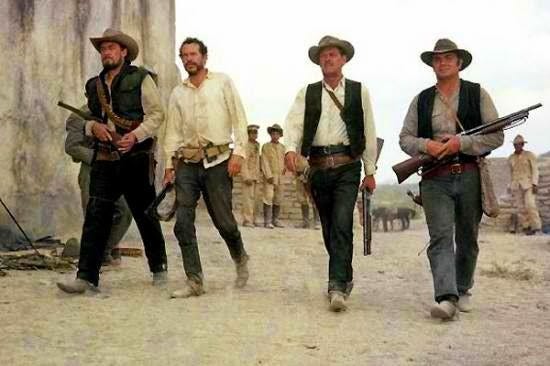
The Wild Bunch
What it does have is a thespian murderer's row of American actors: Ben Johnson, Warren Oates, William Holden, Ernest Borgnine, Edmond O'Brien, Strother Martin, and the great Robert Ryan, among others, all of whom deliver indelible performances in a film so tightly constructed that there's not an ounce of fat anywhere. Sam Peckinpah was at the peak of his creative powers when he directed The Wild Bunch, and if you haven't seen it, you owe it to yourself to do so. It's a truly great film — and part of what makes it great is Warren Oates.***
Oates made some bizarre movies, perhaps the most extreme being Bring Me the Head of Alfredo Garcia, in which he spends a good portion of the movie driving through Mexico mumbling to himself with a severed head in a gunny sack sitting next to him on the front seat of the car. But whatever roles he took, Warren Oates owned the screen — when he was there, you could not look away. As film writer David Thomson wrote: "It's hard to think of Oates playing an unqualified optimist. There's something in his face, the way he looks at things, that suggests a readiness for failure or darkness."
That's classic British understatement, because however much you might like the troubled-but-charming rogues Oates excelled at portraying, there was seldom any doubt things would go badly for him in the end.
The best way to appreciate Warren Oates is to see his films, but if you're wavering on that, check out Across the Border (supposedly available on Mubi, whatever that is — I saw it on YouTube a few years ago), a documentary about Oates narrated and co-produced by Ned Beatty. It's less than an hour, but gives a good sense of who and what Warren Oates really was — a uniquely gifted and compelling actor.
After that, see The Wild Bunch. Anybody who claims to have studied film but hasn't seen that movie has an incomplete education at best. Not only will you enjoy a terrific movie (and in the process learn something about constructing tight, suspenseful scenes without space ships or computer graphics), you'll experience the incandescent glory of Warren Oates on the big screen.
His death at age 53 came as a shock. Warren Oates was just getting started, and the heart attack that killed him cheated the movie-loving world out of another twenty years of memorable roles. So goes life, I suppose, where too many of the good die young while legions of evil MF'ers linger into a rank and overripe old age before shuffling off Shakespeare’s mortal coil.
Warren Oates was an American original, and something very special. Do yourself a favor and check out some of his moves. They’re worth your time.
Postscript: I should note that my harsh opinion of Two Lane Blacktop is not shared by everyone, and maybe I really should watch it again before casting judgment in stone. “Your mileage,” as the saying goes, “may vary,” so for a spectrum of different views on the film, check out these links.
Rotten Tomatoes
Looking for Two Lane Blacktop
New Yorker Movie of the Week
Two Lane Blacktop
* I'll have more to say about Lady from Shanghai another time.
** To be fair, James Taylor was a very good folk/pop musician —not an actor — so it wasn’t reasonable to expect such a gentle man to deliver a convincing performance as a tough-talking, hard-ass drag racer. Bad casting will kill a movie every time.
*** You have doubts? Read this, then make sure you see the studio version. For all the crap Sid Sheinberg took from the creative community for overseeing a few small-but-crucial cuts, the ambiguity in his version of "The Wild Bunch" serves the narrative better than the Peckinpah Director's Cut. Hey, everybody needs an editor.
Good read. Thanks for reminding me to dig up a viewing of The Wild Bunch.