
Roar
Not your average independent film

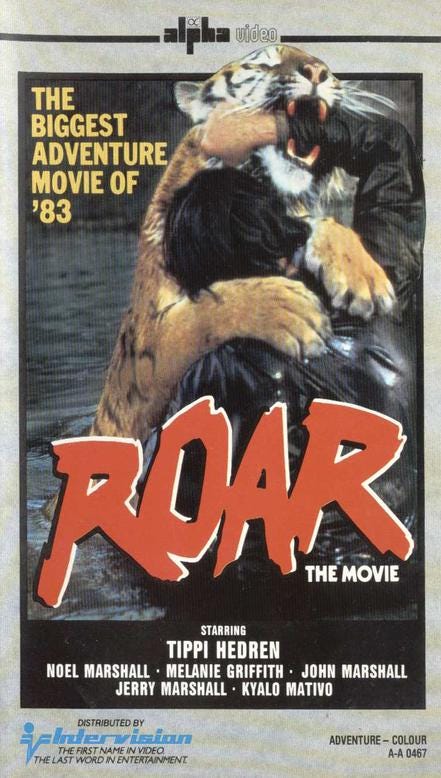
The road not taken …
(Note: here’s another from the archives.)
While wandering the wilds of cyberspace recently, I came across this, which sent my mind spinning back into the past. That’s been happening a lot lately, which means either I’m getting too goddamned old, or maybe it’s time to go back to work. I don’t much like the sound of the former, so I’ll just have to wrap myself in the warm blanket of denial and opt for the latter.
Well before I fell off the turnip truck and rolled into Hollywood, Noel Marshall and Tippi Hedren had embarked on the long and grueling production of an independent feature called Roar. As the title indicates, the drama had a lot to do with big cats — very big cats. On their desert compound north of Los Angeles, Noel and Tippi had assembled more than 130 lions, tigers, panthers and jaguars to use in their extremely expensive home movie.
Since every one of those big cats was real — no CGI back in those days — this was an incredibly dangerous project. By the time it was over, seventy people on the cast and crew had been injured, including Tippi’s daughter (the young Melanie Griffith) and cinematographer Jan de Bont, who was nearly scalped by a lion that took a swipe requiring two hundred stitches to close.
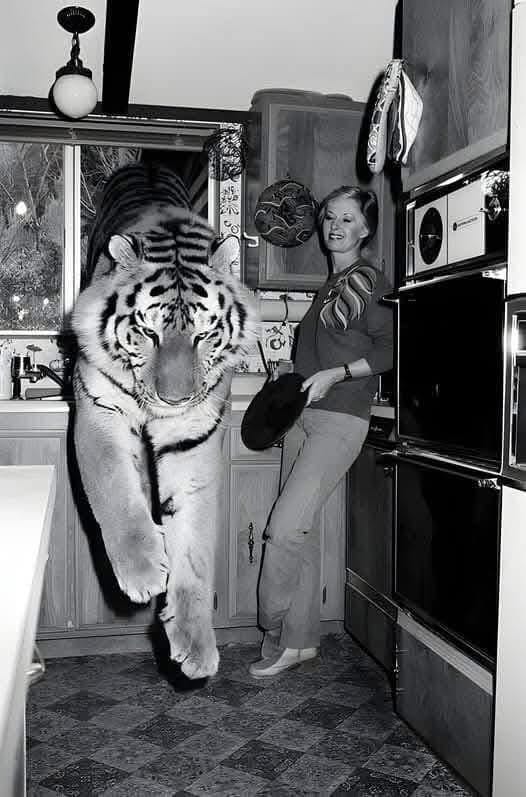
A very big kitty
Between the ever-diligent legions of PETA and modern set safety protocols, I don’t think it would be possible to shoot a film like Roar in California these days. For better and worse, those were simpler times.
Noel and Tippi persevered through all the difficulties, halting production when necessary, then gearing up again. A violent storm ripped through the compound one night, releasing many of the big cats into the surrounding desert community north of LA. Several were shot by police in the chaos that followed. The storm also wrecked the crew housing facilities, dealing a one-two punch to the production. Given the start-stop nature of the job, crew members came and went, which is how half of non-union Hollywood ended up working on the movie at one time or another.
By then I’d come to town, and — after a few months of staring at the smog and wondering what the hell I’d gotten myself into — had begun working and gaining experience. By the time the Roar production got around to calling me, I’d left the PA ranks and was working sporadically as a grip-trician. I’d heard about the movie, of course, and was intrigued by the idea of working around all those big cats, but the deal was lousy: $250 flat, working a six-day week.* That might have been tolerable if they’d provided a room out there, but with the crew housing gone, my choice was to stay in a hotel on my own nickel, thus eating up half my paycheck, or make the 120 mile round-trip commute every day. Driving would be marginally cheaper (my car was a wheezing Oldsmobile V-8 that — in a tailwind — got 15 m.p.g.), but adding two + hours of drive time to each twelve hour (or more) work day was a deal-breaker.
Despite all that, I might have taken the job if they’d asked me to work as a grip or juicer — meeting a new crew and gaining experience might have been worth it — but they wanted me to be the generator operator, which meant being stuck next to the genny in the heat of the desert breathing diesel fumes all day long.
Another minor detail: I knew nothing whatsoever about running a generator at the time.**
Still, I struggled with the decision. The deal sucked, but it was a job on a movie ... so I called a key grip for advice: a very experienced guy I’d worked with, and for whom I had a world of respect. His reply was blunt.
“Only an asshole would take that job.”
I turned it down and moved on. My phone rang with other offers, and I gradually moved up the ladder from juicing to Best Boy, and finally Gaffer. As luck would have it, my Best Boy by then was among the many who’d crewed on Roar, and told great stories about the experience … some of which seemed a bit too good to be true, so I listened with the proverbial grain of salt. Sensing my skepticism, he brought a videotape to work one day. We were working long hours, and I told him I didn’t know when I’d have time to sit down and see the movie.
“Don’t bother,” he said, with a knowing smile. “Just watch the first half hour.”
So I popped the cassette into the VCR when I got home, then poured myself a stiff drink and settled in. The opening sequences were interesting, but nothing unusual, then the action moved to the main set, a big, rambling two-story house where the family lived.
My jaw dropped. I’d never seen so many big cats on screen before — there were dozens of lions in front of the house, lying on the porch, inside the front door, all over the first floor, crowding the stairs and on up to the second floor. The actors waded through that ocean of lions like Moses parting the Red Sea, as if they were just overgrown house cats.
My eyes took all this in, but my brain could hardly grasp it. Everything my Best Boy had said was true, and then some — if anything, he’d understated how many lions were on that set.
There’s lots of information on the web about Roar, including this eye-opening piece that shows just how casual the entire Marshall/Hedrin family was about living with those huge cats, and a post on Black Hole Reviews features photos from the set, including a gruesome shot of Jan de Bont’s head after it was stitched up.
At this point — thirty-five years later — I have mixed feelings about passing up my chance to work on Roar. I didn’t know enough back then to understand that I could probably have worked my way off genny duty and onto the set as a juicer or grip — especially once the production realized I had no idea how to run or service a generator. No doubt I’d have been scared as hell in such close proximity to so many big cats, but that was a once-in-a-lifetime opportunity, and part of me will always wish I’d experienced it.
So it goes. Choices come with the turf in life, and none of us can do it all. Although I can’t really recommend the film as a cinematic drama, Roar is quite a spectacle, especially when you consider the behind-the-scenes backstory. If you don’t have the time, inclination, or patience to sit through it — and assuming you have Amazon or Apple TV — check out Roar: The Most Dangerous Movie Ever Made, a forty-minute documentary about the making of the movie. It’s a real eye-opener — if you’re at all curious about “Roar,” this doc is definitely worth your time.
As for me, Roar will always represent the road not taken.
* “Flat” meaning a flat rate, with no overtime no matter how long the day goes. $250 back then would be toughly $1200 in 2025 money, which doesn’t sound too terrible until you consider those six-day work weeks.
** A few years later I’d work as the set lighting Best Boy on a non-union feature in the snows of Vermont, where my duties included running the genny and doing periodic maintenance — changing the oil, filter, and fuel filters to keep that big beast humming through those cold days and nights — but all that lay in the future.
Take a look also at Savage Harvest, another lion epic, shot in Brazil. Yours truly was the Key Grip.
Monty says -- Half of the adventure of ROAR was just surviving it. You were better off not being on it than actually being there. Our mutual friend lasted three days when he was confronted with a giant tiger, decided he'd best find work elsewhere. As for myself, I got split from my navel up across my forehead by a young teenage lion who just wanted to play. But we were able to complete the dolly move before things got any worse.